
Yazar arşivleri: Editor

Publisher and Articles (Volume: 11, Issue: 4) | Makale Yazarı ve Makaleler

Publisher and Articles (Volume: 11, Issue: 4) | Makale Yazarı ve Makaleler

  INDEX | İÇİNDEKİLER  Pages|Sayfalar
* Publication Period: 36 – Year: 2018 / Editorial Board  I-VI
** A Few Things About Our Future Issues / Editor  I-VI
1 Water Efficient Use for Sustainability of Water Resources in Urban Areas: Xeriscape / Kentsel Alanlarda Su Kaynaklarının Sürdürülebilirliği İçin Suyun Etkin Kullanımı: Kurakçıl Peyzaj Düzenleme
/ Işık SEZEN, Aslıhan ESRİNGÜ, Kübra Sema YARDIMCI
474-485
2 The Spatial Quality in Public Space and the Society; the Example of Eminönü Tahtakale / Kamusal Alan Toplum İlişkisinde Mekansal Kalite; Eminönü Tahtakale Örneği / Emir ÇEKMECELİOĞLU, M. Ebru ERDÖNMEZ 486-507
3 Harmony of Sultanahmet Square Urban Furnıture wıth the Urban Fabrıc ın Terms of Aesthetıc, Functıonalıty and Perceptıbılıty Benchmarks / Sultanahmet Meydanı Kent Mobilyalarının Estetik, İşlevsellik ve Algılanabilirlik Ölçütlerinde Kent Dokusu ile Uyumu/ Handan ÖZSIRKINTI KASAP, Melisa Elif İLHAN 508-522
4 Planning/Design and Planning Priority in Urban Transportation-Transit-Focused Development Metropol Experience in The Cities, Sample of Istanbul / Kentsel Ulaşımda Yaya Öncelikli Planlama/Tasarım ve Transit Odaklı Gelişimin Metropol Kentlerdeki Deneyimi, İstanbul Örneği / Pınar KIRKIK AYDEMİR, Bilgehan AKYÜZ, Burak Kaaan YILMAZSOY, Çiğdem AKDEMİR, Süleyman GÜLER
Pınar KIRKIK AYDEMİR, Bilgehan AKYÜZ, Burak Kaaan YILMAZSOY, Çiğdem AKDEMİR, Süleyman GÜLER
523-544
5 Determınatıon Of Flood Hazard Maps Wıth Geographıc Informatıon Systems / Coğrafi Bilgi Sistemleri İle Taşkın Tehlike Haritalarının Belirlenmesi / Gül USLU, Faik Ahmet SESLİ, Bayram UZUN 545-558
6 Stadyum’s Evolution In The Historical Context of Sport SpacesSpor Mekanı Olarak Stadyum’un Gelişimi / Khaled SELO, Ebru ERDÖNMEZ 560-574
7 “No Hurry My Friend” The Challenge of Human to Spatial Dependency / “Acele Yok Arkadaş” İnsanın Yere Bağımlılığa Meydan Okuması / Hatice KARAKUŞ ÖZTÜRK  
8 A Case Study in Urban Transformation: Parameters of Urban and Social Infrastructure Kentsel Dönüşümde Bir Senaryo: Kentsel ve Sosyal Altyapı Parametreleri / Halil İbrahim POLAT 585-590
9 Urban Transformation Implementations; Gülistan District of Isparta Example / Kentsel Dönüşüm Uygulamaları; Isparta Gülistan Mahallesi Örneği  / Bora BİNGÖL, Ayşe Betül GÖK 591-599
10 Urban Transformation Applications Within The Context Of Protecting Cities’ History And Cultural Texture / Kentlerin Tarihi ve Kültürel Dokusunun Korunması Bağlamında Kentsel Dönüşüm Uygulamaları / Murat SEZİK 600-608
11 The Effect of Time-Changing of Urban Areas on Air Pollution / Kentsel Alan Kullanımlarının Zamansal Değişimlerinin Hava Kirliliği Üzerindeki Etkisi / Ahmet KOÇ 609-617
12 An Investıgatıon Of Traffıc Accıdents In Ankara / Ankara İlinde Meydana Gelen Trafik Kazalarının İncelenmesi
/ Ömer UYURCA, İbrahim ATILGAN
618-626
13 The Representation of Women Identitiy at Marriage Programs at Tlelevision / Televizyonlardaki Evlilik Programlarında Kadın Kimliğinin Temsili / Hakan YÜKSEL 627-639
14 Outcomes of The Project Named “Children! There Is Art in The Soil” In Terms of Children’s Visual And Plastic Language Development” / Çocuklar! Toprakta Sanat Var” Adlı Projenin Çocuğun Görsel ve Plastik Dil Gelişimi Yönündeki Çıktıları / Ceylan SEBİK 640-653
15 The Evaluatİon Of Bergama-İzmİr In The Context Of Sustaİnable Cıty And Urban Identity / Sürdürülebilir Kent ve Kentsel Kimlik Bağlamında Bergama/İzmir Örneğinin Değerlendirilmesi / Demet GÜLHAN 654-672
16 Positivism, Chicago School of Urban Ecology and
Urban Safety / Pozitivizm, Chicago Kent Ekolojisi Okulu ve Kent Güvenliği  / Orçun ÇOBANGİL
673-682
17 Living Witness to History: Çiğ Lake (Mesudiye, Ordu, Turkey) Tarihin Yaşayan Şahidi: Çiğ Gölü (Mesudiye, Ordu, Türkiye) Beyhan TAŞ, Burcu KARAKAYA 683-691
18 Effects Of Artificial Intelligence on Art / Yapay Zekâ Kullanımının Sanata Etkileri / Abdül TEKİN 692-702
19 An Evaluation for Turkey in the Context of International Sustainable Urban Criteria / Uluslararası Sürdürülebilir Kent Ölçütleri Bağlamında Türkiye İçin Bir Değerlendirme / Çiğdem TUĞAÇ 703-740
*** Volume: 11, Issue: 4, Period: 35, Winter 2018 Ful Page 474-740


From the Editor: Urban Regeneration Problem and Horizontalization Trends in Metropolitan Regions

We are together again with a tiring and full-fledged page. Our 36th edition coincided with December and the birth of the December issue of academic journalism is another stress and painful. This time next year, we will publish our 40th edition, and we will start our editorial writing  saying 41 times of Mashallah.

As time goes by, it’s  like ‘a passengers on the road ’ our magazine continues the development process.Each number adds new field editors. In this issue, with a new participating of our field editors, Prof.Dr. Tuğba KİPER, Assoc. Prof. Dr. Candan KUŞ ŞAHİN, MD Betsy SULLAM HALFON, Oylum GÖKKURT BAKI our broadcasting table has increased to 33 branch editors.

From this issue, we prepared the Main Branch editorship (Main science / Main arts branch)and field editorship (Science / Art Branch) as preparation for 2019. Almost with the power of knowledge, we formed the upper class academy of the city.

Dear Authors:

Before we  take the referee process, in principle, each article (sent within the period of publication) ,  passing through the Itenticate program.

However, in the following processes, articles submitted without using our article template, will be left to the usual flow , if the articles are created according to the template we would like to state that the followed  status will be given priority . As of 2019, our journal will start to give DOI.

Our aim is to make our Kent Academy magazine a source of pride for our country in the scientific community, and  within a few years,  to become the focus of  interdisciplinary, multidisciplinary, and transdisciplinary studies of the  world science environment , via taking part of  indexes such as SCI, SSCI, ISI.

The Bleeding Wounds of Our Cities: The Problem of Urban Regeneration and Unbalanced Horizontal Stitching Trends in Metropolitan Areas

As it is known, cities that absorbed the population of the 1960s  rural areas have formed the cities where human masses live in the name of Megapol due to unplanned irregular structures without infrastructure. After the 1990s and especially in the 2000s, both in terms of infrastructure and superstructure, it has been forced to experience both the structure and the mentality revolution in the geography that has been transformed into such a chaos.

The places that have undergone urban change in terms of structure had to live the process of urbanization with a mentality. They learned that ,unstable  buildings would damage first  of all to themselves , If  they  stand, they should be positioned on the right and give way to fast passers (foreseeing that those have a right who want to go faster on the escalator are entitled), not leaving shoes in front of doors in apartment buildings.  Just as the educators did the training by learning new things themselves, our cities became cities learning with their structures and people.

Trend: From Engineering to Architecture, from Vertical to Horizontal

Today, the construction processes of the structures are technically practical and the structures of the automation system have started to be constructed and the engineering dimension of the structure has become known and predictable. The practicality and ease-of-the-step process of this dimension has led to detailed trends from engineering to architecture. Especially in the last 50 years, urban centers have been carrying a vertical upward trend, while yesterday’s suburbs and eaves have been caught in this verticalization wind.

Since the 1950s, suburbs have been subject to distorted construction, and since 2000, urban transformation has become inevitable, especially after the Gölcük and Sakarya earthquakes. Hereby, so to speak , for take advantage of , it has been influenced via uptrend at the city center. In other developing world cities, similar characteristics are observed for such regions and structures.

From the city center to suburban and satellite cities, the Metropolitan Region Renewal continued its upward trend and was under the centrifugal effect of growth as a result of dizzying developments in transportation and communication techniques and technologies.

The vertical tendency in the structures in these skidding areas was replaced by the new manor areas as they were replaced by the center. At this point, metropolitan cities, with the effect of reverse migration, merged with several metropolitan areas and turned into metropolitan areas. In the meantime, the next 100 years will be spent with the development and infrastructure of the mansion areas spread over suburban areas.

Yes, precious readers, again from this day to the future, we have put forward a horizon line although we use hand procedure though.

In the March 2019 issue of our journal, we will focus on Environmental Management and Policies.

In the June 2019 issue, we will also focus on the ZERO WASTE agenda as a detail of the environmental theme. In the hope of meeting the more beautiful and bright tomorrow,my dear.

Okumaya devam et

Publisher and Articles (Volume: 11, Issue: 3) | Makale Yazarı ve Makaleler

Publisher and Articles (Volume: 11, Issue: 3) | Makale Yazarı ve Makaleler

INDEX | İÇİNDEKİLER  Pages|Sayfalar
* Publication Period: 35 – Year: 2018 / Editorial Board  I-VI
** A Few Things About Our Future Issues / Editörden

 I-VI
1 Evaluation of the Factors Affecting Preferences and Preferences for Urban Transportation Systems by Analytic Hierarchy Process / Kent İçi Ulaşım Sistemlerine İlişkin Tercihlerin ve Tercihlere Etki Eden Faktörlerin Analitik Hiyerarşi Prosesi Yöntemi İle Değerlendirilmesi / Ömer Faruk GÖRÇÜN 345-356
2 Relation Between Migrant Smugglers and Marine Tourism Craft Managements and Suggestions of Solutions / Deniz Turizmi Araçları İşletmeciliğinin Göçmen Kaçakçılığıyla İlişkisi ve Çözüm Önerileri Aziz MUSLU 357-366
3 Transportatıon Investments And Urban Space Relatıonship / Ulaşım Yatırımları ve Kentsel Mekân İlişkisi / Kübra ÖZBAY 367-373
4 Wolkswagen Emission Crisis And The Role Of Public Relations During Crisis Management / Volkswagen Emisyon Krizi ve Kriz Yönetiminde Halkla İlişkilerin Rolü ve Etik Değerler / Taha Oğuzhan ÖZCÜRE 374-389
5 Analyse of Implementation Plans in Terms of Impacts of Traffic Noise Values The Case of Samsun Atakum Region / İmar Planlarının Trafik Gürültü Değerlerinin Etkisi Açısından İncelenmesi, Samsun Atakum Bölgesi Örneği İbrahim ÖNER, Faik Ahmet SESLİ 390-404
6 Effects of Customer Complaint Management Performance on Customer Satisfaction in Public Sector / Kamu Sektöründe Müşteri Şikâyet Yönetimi Performansının Müşteri Memnuniyetine Etkisi / Haydar ALP, Necmiye Tülin İRGE 405-418
7 Modelling of Billing Fast Paying In Mobile Applications In Citizen-Focused Services In Smart City Systems / Akıllı Kent Sistemlerinde Vatandaş Odaklı Hizmetlerde Fatura Hızlı Ödemenin Mobil Uygulamalarda Modellenmesi Muhittin ÜSTÜNDAĞ, Tuncer TOPRAK 419-426
8 The New Day in the Ancient World Tarih The 6000 Years Historical Story of the New Year and the New Year Celebration Tradition Antik / Yakın Doğuda Tunç Çağı ve Sonrasında ‘Yeni Gün’ / Ebubekir BAYRAM 427-436
9 Teenagers with autism Related to Children’s Park 2-8 in the Istanbul Provincial Parental Opinions and suggestions / 2-8 Yaş Arası Otizmli Çocukların Ebeveynlerinin İstanbul İlindeki Parklara İlişkin Görüş ve Önerileri Figen ALTINER, Hakan ALTINÇELİK, Oktay TAYMAZ SARI 437-443
10 Investıgatıon Of Elazığ’s Current Natıonal Strategıc Noıse Maps Wıth A Survey Study / Elazığ İli Mevcut Stratejik Gürültü Haritalarının Anket Çalışması İle İrdelenmesiSelim TAŞKAYA, Faik Ahmet SESLİ 444-458
11 Urban Identity Components in Denizli / Denizli’de Kent Kimliği BileşenleriGizem ERDOĞAN, Seçil ÇORBACIOĞLU AKAY 459-473
*** Volume: 11, Issue: 3, Period: 34, Autumn 2018 Ful Page 345-473

From the Editor: Transportation and Communication are the Basis of Mobilization in Urban Areas


Dr. Ahmet FİDAN

On behalf of editorial board

Urban Development is, like the development of Plant Cells!

From the Editor

In our thirty-fifth publication period our focus is again on the original and current academic studies which are aiming the examination, scrutinization, and analization of the issues and problematiques of the superstructures and substructures in urban areas.

As we have announced in the last issue, we will present thematic content in this issue. As we mentioned in the title, we tried to show that especially the healing process of the superstructure and substructure in urban areas is a dynamic structure, while considering the cities equal with the development of plant cells. As Ibn Khaldun has stated in his works, states have a life, they are born, grow, and die. Although there is a lifetime of states based on a certain piece of land, cities do not have.

Urban areas, like plant cells, protect their existence with their flexible structures firstly with constantly renewing themselves, then they maintain their life with protecting this structure after taking or establishing their identities. The process of maturation in cities is similar to the process of wisdom and specialization in humans. As cities enter the maturation period, which requires a period of at least three hundred or four hundred years for a city, the periods of stagnation represent their periods of grandeur. A city at this level is already referred as “ancient city”, and categorized by the united nations as ‘cittaslow’ firstly, and then the ‘ancient city to be protected’.

Transportation and Communication are the Basis of Mobilization in Urban Areas.

While the development processes of the cities are in this position, transportation on one side and institutionalization in the communication sectors on the other side they both have an accelerating effect on the maturation processes of cities.

The urban, inter-city or international transportation systems become part of the institutionalization of cities as long as they are in accordance with the ergonomics of social needs, and adapt to the global accreditations. Otherwise, the cities where accreditation, integration and synchronization do not work will not only sabotage their own future, but also prevent the development of other cities around the world. Also, the sub-structures and systems which are indifferent to the needs of the city dwellers in cities cause the isolation of that city in particular and country in general. In this respect, the transportation infrastructure in a city requires a harmonization in the means of transport on a species basis on one hand, and also in terms of transportation techniques or methods on the other hand. The work also requires the combination of the same transport systems and infrastructures with the transport systems of other countries. In this context, overlapping of the transportation types and techniques with the transportation systems of the developed cities in the world in line with the developing technological means, have vital importance in the development of the tourism potential of that city in particular and country in general.

Because the development process of the communication systems between people is proceeding in geometric speed, it requires the flexibility and accreditation of urban infrastructures at the point of mobilization of the citizens.

Geometric speedly developing communication systems are a driving and compelling factor in the synchronization of transportation networks in the context of time, orer arrangements, compensation systems, and means of transportation. The structures supported by the transportation software which should be a part of the “big data” which is determined with a fuzzy logic, became an inevitable situation in our world which is a global village.

New Sector in The World: Street Economy, Micron Entrepreneurship
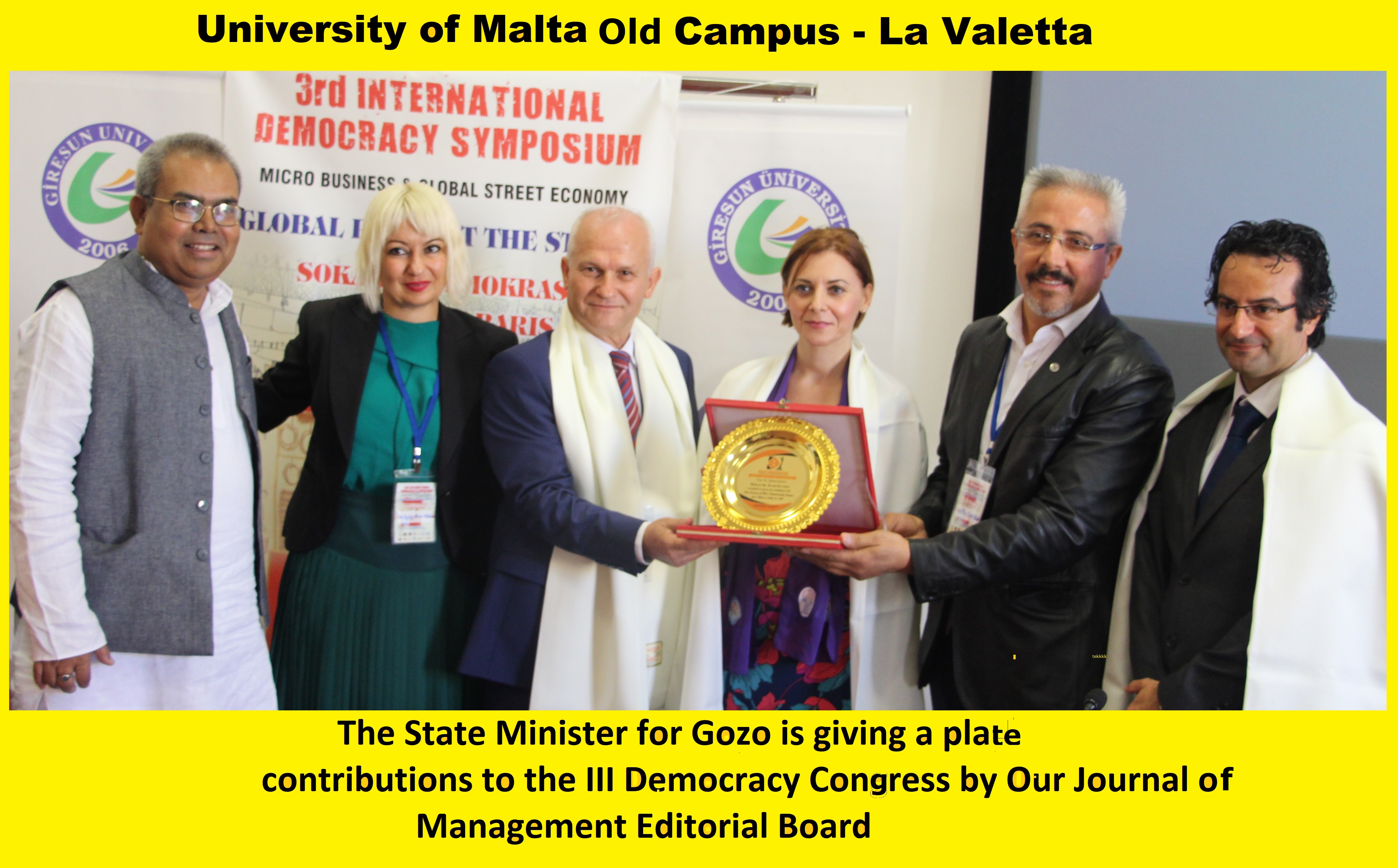
The academic and sectoral initiatives of the assistant editor of our journal Osman SIRKECI, about the formation of a new sector which known as Street Economy or micron entrepreneur all around the world are continuing. In this context, The Global Street Economy Congress which the first one was held in Malta Valetta and our journal is in the editorial board and secretariat, was held with the theme of the III. Democracy Symposium in a dynamic, energetic and synergistic atmosphere. In the context of placing the street economy within the sector, this movement which has developed between the world countries on the economic basis as a hope to our aging and polluted world, has also undertaken the mission of being a bridge between states and cultures.

Under the leadership of Mr. Sirkeci, the Malta Conferences supported by the State Minister of Malta within the scope of our work on Global Street Economy, includes many new countries. The snowballing movement is rapidly Okumaya devam et

Publisher and Articles (Volume: 11, Issue: 2) | Makale Yazarı ve Makaleler

Publisher and Articles (Volume: 11, Issue: 2) | Makale Yazarı ve Makaleler

INDEX | İÇİNDEKİLER  Pages|Sayfalar
* Publication Period: 34 – Year: 2018 / Editorial Board  I-VI
** A Few Things About Our Future Issues / Editörden

VII-IX
1 Economic Mission and Future Perspective in Urban Management / Kent Yönetiminde Ekonomik Misyon ve Gelecek PerspektifiNihat KURT 214-231
2 The place of Nanotechnology in Architecture /Mimarlıkta Nanoteknolojinin Yeriİnanç ATİK, M. Burak BİLGİN 232-242
3 The Concept of Urban Design Place and importance of Urban Design Guides / Kentsel Tasarım Kavramında Kentsel Tasarım Rehberlerinin Yeri ve Önemi / Serdar ARISU 243-255
4 Innovative Approaches for Tourism: The Impact of Cittaslow / Turizm İçin İnovatif Yaklaşım: Cittaslow EtkisiRuhet GENÇ 256-263
5 The Concept of “Smart Cities” in Terms of Evolution and Meeting with Reason: How Cities Become Intelligent? Geodesign Approach / Evrilme ve Aklıyla Buluşma Açısından “Akıllı Şehirler” Kavramı: Şehirler Nasıl Akıllı Olur? Geotasarım Yaklaşımı / Saffet ERDOĞAN, Recep ASLAN, Mustafa ULUKAVAK, Mehmet YILMAZ 264-273
6 Structural and Spatial Characteristics of Turkish Hamam Architecture / Türk Hamam Mimarisinin Yapısal ve Mekânsal Özelikleri / Elif ÇELİK, Ali Işık AYDEMİR 274-281
7 On Architecture and Paradoxical Difference / Mimarlık ve Paradoksal Fark / Önder ÇELİK 282-288
8 Bioclimatic Conservation Impact of Different Field Usage: Bingöl Province Case / Farklı Alan Kullanımlarının Biyoklimatik Konfora Etkisi: Bingöl İli ÖrneğiAhmet CAF, Ahmet KOÇ, Canan KOÇ 289-294
9 Human Rights, Justice and Equity in terms of Clean Development Mechanism as an Instrument of Climate Policy /İklim Politikasının Bir Aracı Olan Temiz Kalkınma Mekanizması Açısından İnsan Hakları, Adalet ve Hakçalık / Ferhan CAN 295/304
10 Strategic Management Approach in Local Governments / Yerel Yönetimlerde Stratejik Yönetim YaklaşımıŞadiye GÜNGÖR, Ender KUTLU 305-316
11 Nation Ideology and Its Components as a Roof Concept in the Republican Era Cumhuriyet Döneminde Bir Çatı Kavram Olarak Ulus İdeolojisi ve Bileşenleri / Sait YILDIRIM 317-331
12 Assessment of Bediuzzaman Said Nursi’s Approach to the Local Qualities of the Kurdish District in the Decentralisation Case / Adem-i Merkeziyet Fikrine Bediüzzaman Said Nursi’nin Kürd Muhitinin Yerel Vasıfları Açısından Yaklaşımının DeğerlendirilmesiErdal AYDIN, Aynur ATMACA CAN 332-344
*** Volume: 11, Issue: 2, Period: 34, Summer 2018 Ful Page 345-508